Preface
Recently, our firm has observed a distinct tightening in the application of the prohibitive provisions of the Trademark Law during substantive examination. Descriptive or suggestive terms that were previously considered potentially registrable are now frequently facing absolute grounds for refusal. This shift is profoundly impacting corporate trademark portfolios and branding strategies.
Evolving Examination Practices: Increasingly Stringent Application of Prohibitive Provisions
Trademark examination authorities have consistently maintained strict standards when applying prohibitive provisions, such as Articles 10 and 11 of the Trademark Law. Recent practice, however, indicates these standards have tightened further. We have observed a significant increase in instances where descriptive terms, which might have passed preliminary examination in the past, are now being directly refused under these articles.
For example, in a case our firm handled for the trademark "XX Jia Yan" (XX Fine Feast), the mark itself was not found to violate prohibitive provisions for its core services in Class 43, such as "hotel accommodation services; catering services; restaurants." However, for other services within the same class, like "providing meeting rooms; nursing homes; day-nurseries [crèches]," the examination opinion explicitly stated, "Using this sign on the aforementioned services could easily mislead the public regarding the nature and characteristics of the services, thus it shall not be used as a trademark." This illustrates that examination authorities are applying prohibitive provisions with greater precision and strictness, where even the same mark can be treated differently across related services based on the specific nature of those services.
Similarly, based on past practice, terms like "You Xuan" (meaning 'superior choice' or 'carefully selected') in trademarks such as "XX You Xuan" were rarely directly refused under prohibitive provisions due to their perceived weak distinctiveness. However, recent examination opinions have explicitly stated that such terms "could easily mislead the public regarding the quality and characteristics of the goods." This further tightening aligns closely with the spirit of the recent "Notice on Strengthening the Administration of Trademark Use" issued by the China National Intellectual Property Administration (CNIPA). The notice emphasizes the governance of unregistered trademarks that are prohibited, including those with deceptive elements, and explicitly lists non-compliant usages containing terms like 'exclusively supplied for', 'specially supplied for', 'top-grade', 'selenium-enriched', 'organic', 'zero-additive', etc., demonstrating a coordinated tightening of examination and enforcement standards.
This shift is not merely about examining individual words; it reflects an upgrade in the authorities' criteria for determining whether a trademark sign is likely to mislead, lacks distinctiveness, etc. In response, agents advise clients to fully recognize and account for this change when formulating trademark filing strategies and to adjust their application plans promptly.
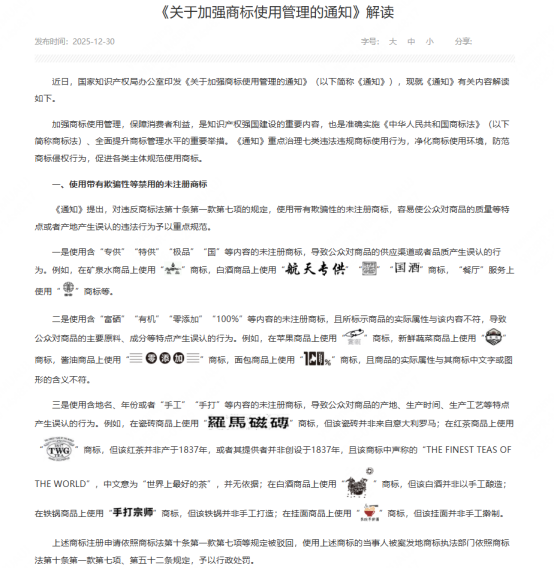
Screenshot of Notice on Strengthening the Administration of Trademark Use released by CNIPA
Jurisprudential Analysis and Practical Application of Prohibitive Provisions
Articles 10 and 11 of the Trademark Law collectively form the system of prohibitive provisions for trademark registration. Their legislative purpose is to maintain fair competition order, protect consumer interests, prevent public misleading, and prevent improper monopolization of public resources.
Article 10 stipulates the types of signs that shall not be used as trademarks, including national symbols, signs with ethnic discrimination, and deceptive signs. These provisions are absolutely prohibitive; violation renders a mark ineligible for registration. Article 11 stipulates circumstances where a sign shall not be registered as a trademark, primarily targeting marks lacking distinctiveness, but allowing exceptions where distinctiveness has been acquired through use.
In current examination practice, the application of the following clauses warrants particular attention, as clients often overlook their stringent standards:
Article 10, Paragraph 1, Item (7): "Signs that are deceptive and are likely to mislead the public as to the quality or origin of goods or services shall not be used as trademarks." According to the Trademark Examination and Adjudication Guidelines, examiners consider factors such as the inherent meaning of the sign, the designated goods/services, and the perception of the relevant public. Clients often overlook that for signs directly or indirectly suggesting specific qualities, functions, or uses of goods/services—even if clients consider them mere advertising slogans—examination authorities may deem them deceptive based on the current stringent standards. The determination is not based on the applicant's subjective intent but on the objective perception of the general public, a standard that is continuously being clarified and refined in practice.
Article 11, Paragraph 1, Item (2): "Signs that merely directly indicate the quality, main raw materials, function, use, weight, quantity or other characteristics of the goods shall not be registered as trademarks." This clause aims to prevent operators from improperly monopolizing descriptive expressions that should remain in the public domain through trademark registration, ensuring fair market competition. In practice, such signs directly describing the features of goods/services typically lack inherent identifying function and struggle to gain trademark protection. For example, using taste-descriptive words in the food category or material-descriptive words in the clothing category are easily deemed to fall under this provision. Examination authorities adopt a strict stance here; even if a sign contains other elements, if its main part is still understood by the public as a direct description of the product's characteristics, it may still be deemed unregistrable.
Practical Recommendations and Risk Prevention Measures
Faced with continuously tightening examination standards, trademark applicants and agents should adopt more prudent and professional strategies.
01 Professional Responsibilities of Agencies Should Include:
1. Strengthening Pre-filing Risk Assessment: Conduct comprehensive legality and registrability assessments of trademark signs before filing. Specifically, provide early warnings and advise clients to adjust strategies regarding risks associated with prohibitive provisions that clients might overlook.
2. Refining Application Strategy: For signs potentially falling into grey areas, suggest enhancing distinctiveness by adding distinctive elements, modifying the design, or carefully selecting classes to improve registration prospects.
3. Monitoring Regulatory Changes: Continuously track the latest developments in examination practices. Communicate trends to clients promptly and assist enterprises in building trademark portfolios that align with current examination standards.
02 Key Points for Trademark Applicants:
1. Carefully Select Trademark Elements: Avoid terms that could be perceived as exaggerated advertising or deceptive. Pay special attention to descriptive terms clients might view as "harmless" but could potentially violate prohibitive provisions.
2. Prioritize Systematic Evidence Preservation: For marks already in use and possessing a certain degree of recognition, consciously collect, organize, and preserve evidence of use to prepare for potential claims of acquired distinctiveness. Do not underestimate the evidentiary requirements.
3. Objectively Assess Examination Decisions: When receiving an office action, objectively analyze the grounds for refusal. Decide whether to pursue subsequent procedures like review based on law and facts, avoiding blind persistence on potentially unregistrable marks.
Conclusion
The continuous tightening of trademark examination standards is a natural outcome of the evolving intellectual property protection system in China. The recent CNIPA "Notice on Strengthening the Administration of Trademark Use" further reinforces the regulation and governance of improper trademark use, highlighting strengthened oversight across the entire chain from registration to use. While this shift may temporarily increase the cost and difficulty of trademark applications, in the long run, it fosters a clearer and fairer trademark order, promoting the healthy development of the brand economy.
Enterprises should prioritize trademark compliance within their brand strategies. With the assistance of professional agencies, they should build trademark assets that comply with legal norms and possess market value. Only by deeply understanding the legal principles, adopting professional advice, and formulating scientific strategies can enterprises, within an increasingly regulated market environment, truly leverage their trademarks as legal vehicles and value representations of their core competitiveness.





















 鄂公网安备 42010402001546号